
Research by organisations like AKT, Stonewall, and Mind shows that LGBTQIA+ people are more likely to be homeless. Almost one in five LGBTQIA+ people have, at some point, been homeless.
So, what are the reasons?
Discrimination and violence
LGBTQIA+ homeless people face more discrimination and violence on the street and after being supported.
- Sleeping on the street is particularly dangerous for LGBTQIA+ people. As of 2023, hate crimes based on sexual orientation have risen 112% in five years. Hate crimes against transgender people have increased by 186% in the same period.
- Sexual assault rates are much higher for LGBTQIA+ people. Young LGBTQIA+ homeless people are sexually assaulted at three times the rate of their non-LGBTQIA+ peers.
- Hostels and temporary housing often cannot meet LGBTQIA+ people’s needs, especially transgender people. Many services are gendered, making it difficult for transgender people to find appropriate support.
- Even after support, LGBTQIA+ people, particularly transgender people, are at a higher risk of aggression and sexual assault in hostels.
LGBTQIA+ black, Asian and minority ethnic, disabled people and those from low-income backgrounds can face overlapping discrimination, making it even harder to find stable housing. Half of black, Asian, and minority ethnic LGBT people have faced discrimination from the LGBT community because of their ethnicity. This can make it feel like no support network is available when they need it most.
Family rejection
Family rejection causes most homelessness among LGBTQIA+ youth; 77% say it is the leading cause. Over half of young LGBTQIA+ people fear they would be kicked out of their family home if they came out, especially if they come from a religious family. Nearly one in four LGBTQIA+ young people who are kicked out feel they need to enter unwanted relationships to find a place to stay.
 24%
of young people who are homeless are LGBTQIA+
24%
of young people who are homeless are LGBTQIA+
Housing insecurity
Almost 1 in 5 LGBTQIA+ renters have faced discrimination from landlords or letting agents due to their gender or sexual orientation. Same-sex couples are also less likely to receive responses to their rental inquiries from housing providers.
LGBTQIA+ people are 48% more likely to live in unsuitable housing than non-LGBTQIA+ people. One of the main challenges for LGBTQIA+ renters is dealing with landlords. This is especially true when they need repairs.
House ownership is much lower for LGBTQIA+ people. A study found that half of LGBT adults own their homes, compared to 70% of non-LGBT adults. This gap is partly due to discrimination by mortgage lenders. They are less likely to approve mortgages for LGBT people and offer worse rates. Some same-sex couples have been denied housing viewings and purchases by previous owners.
Job Insecurity
A study found that 46% of LGBT workers have faced unfair treatment at work. This includes being fired, not hired, or harassed due to their sexual orientation or gender identity.
Without a stable job, income can be low or inconsistent, making it hard to afford rent or a mortgage.
Workplace discrimination can cause mental health issues. In some cases, it can make work impossible.
Mental health
LGB people are over twice as likely as heterosexual people to have a long-term mental health condition. For transgender people, it is nearly four times as likely. Discrimination, family rejection, and fear of violence that LGBTQIA+ people experience are to blame.
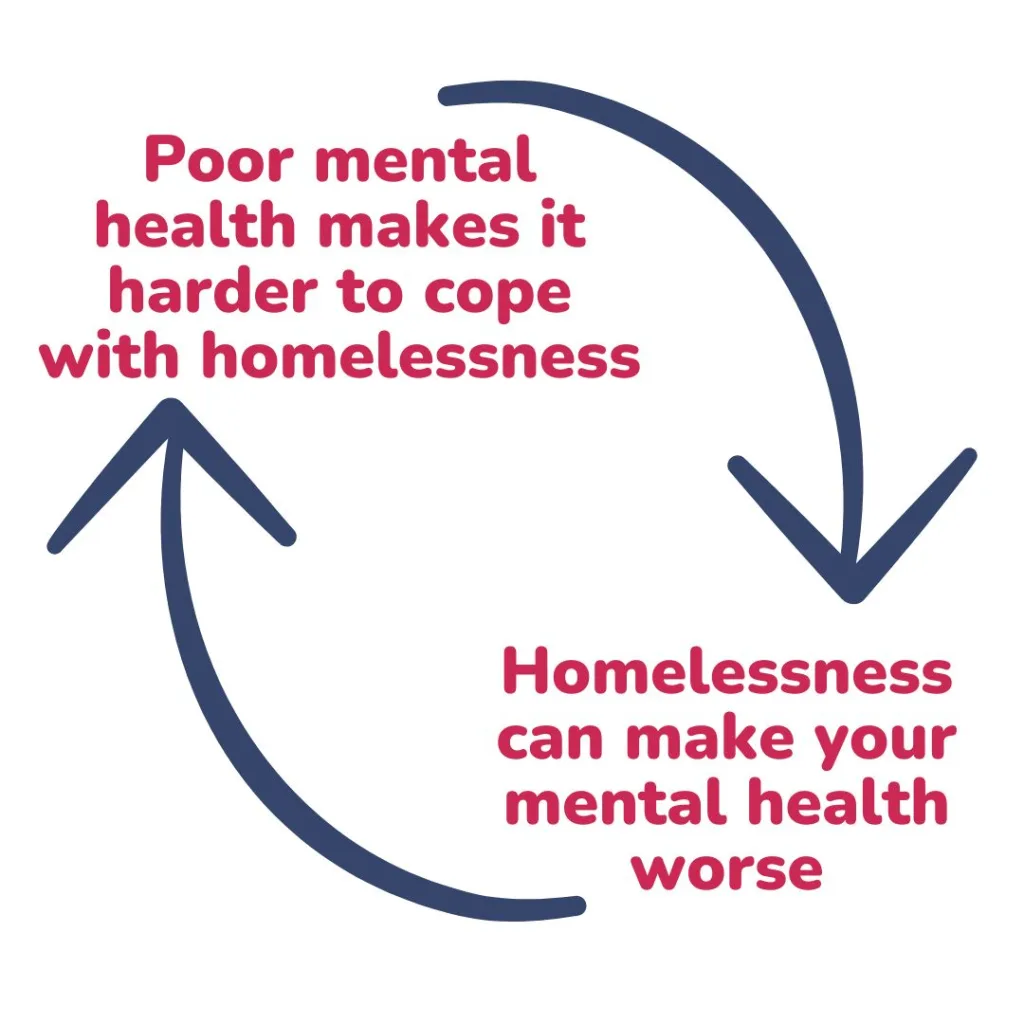
Mental health problems can make it challenging to keep stable housing. Over 60% of our clients have mental health issues, vs. 25% of the general population. For some, the stress of work, rent, and bills can be too much, especially when they have a mental health problem. This can create a cycle of instability. Insecure housing worsens mental health, and those problems, in turn, make it harder to find stable housing. Without proper support, people may fall into homelessness.
Substance use
Drinking, smoking, and drug use are higher among LGBTQIA+ people.
- One-third of LGB people drink over 14 units of alcohol a week, which puts them at risk of causing alcohol-related harm.
- In the UK, 23% of LGB people smoke, compared to 16% of heterosexual people. Young LGB people are also more likely to smoke at a younger age and smoke more.
- A study found that 76% of young people hospitalised for drug use were LGBTQIA+.
Substance use is a way for some LGBTQIA+ people to cope with mental health challenges. When this behaviour leads to addiction, homelessness can become more likely because:
- Addiction can make it hard to meet job expectations, which could lead to job loss or trouble keeping a job.
- Family and friends may become estranged, which could lead to being kicked out or losing a support network.
- Addiction can cause serious health issues, making it hard or impossible to work or handle daily tasks.
- You might lose your home if you neglect responsibilities like managing rent and bills.
What we are doing to support LGBTQIA+ people
It is crucial to understand how barriers facing LGBTQIA+ people increase their risk of homelessness.
To support LGBTQIA+ clients and staff and raise awareness of LGBTQIA+ homelessness, we:
- Create specific Equality, Diversity, and Inclusion training for our staff, helping us support our LGBTQIA+ clients and staff.
- Have an LGBTQIA+ staff network that meets regularly. It develops training and policies and advises our staff and Board on how best to support LGBTQIA+ clients and staff.
- Understand our clients’ needs. Use inclusive, respectful language in all interactions.
- Support and amplify the voices of people and organisations working on LGBTQIA+ homelessness.
If you need support with any of the topics discussed in this article, help is available. Stonewall offers free housing-related advice on their helpline, open every weekday from 10:00 to 13:00. Call 0800 6404 404.
At Single Homeless Project, we believe everyone deserves a safe, secure, and affordable home.
References
- Action on Smoking and Health. (n.d.). Smoking: LGBT people. Retrieved from https://ash.org.uk/uploads/HIRP-LGBT-community.pdf?v=1652365376
- BBC. (2021). LGB people ‘more likely to have mental health issues’. Retrieved from https://www.bbc.co.uk/news/health-57739132
- BBC. (2022). Gay couple refused south London house viewing and purchase. Retrieved from https://www.bbc.co.uk/news/uk-england-london-60115606
- Chang, D.C., Rieb, L., Nosova, E., Liu, Y., Kerr, T., & Debeck, K. (2018). Hospitalization among street-involved youth who use illicit drugs in Vancouver, Canada: A longitudinal analysis. Retrieved from https://harmreductionjournal.biomedcentral.com/articles/10.1186/s12954-018-0223-0
- Conron, K. (n.d.). Financial services and the LGBTQ+ community: A review of discrimination in lending and housing.Retrieved from https://williamsinstitute.law.ucla.edu/wp-content/uploads/Testimony-US-House-Financial-Services-Oct-2019.pdf
- Cray, A., Miller, K., & Durso, L.E. (2013). Seeking shelter: The experiences and unmet needs of LGBT homeless youth.Retrieved from https://www.americanprogress.org/article/seeking-shelter-the-experiences-and-unmet-needs-of-lgbt-homeless-youth/
- HQ Network. (2022). One in five LGBTQ+ private renters ‘experienced discrimination’ from a landlord or letting agent.Retrieved from https://hqnetwork.co.uk/news/one-in-five-lgbtq-private-renters-experienced-discrimination-from-a-landlord-or-letting-agent/
- Schwegman, D. (2018). Rental market discrimination against same-sex couples: Evidence from an email correspondence audit. Retrieved from https://www.maxwell.syr.edu/docs/default-source/research/cpr/working-papers/wp-210-rental-discrimination-against-same-sex.pdf?sfvrsn=1f8d8c41_8
- Sears, B., Neko, C., Lin, A., & Mallory, C. (2024). LGBTQ people’s experiences of workplace discrimination and harassment. Retrieved from https://williamsinstitute.law.ucla.edu/publications/lgbt-workplace-discrimination/
- Spicer, S.S. (2010). Healthcare needs of the transgender homeless population. Retrieved from https://www.tandfonline.com/doi/full/10.1080/19359705.2010.505844
- Stonewall. (2018). LGBT in Britain — Home and communities. Retrieved from https://files.stonewall.org.uk/production/files/lgbt_in_britain_home_and _communities.pdf?dm=1725396243
- Stonewall. (2023). New data: Rise in hate crime against LGBTQ+ people continues, Stonewall slams UK Gov ‘inaction’.Retrieved from https://www.stonewall.org.uk/news/new-data-rise-hate-crime-against-lgbtq-people-continues-stonewall-slams-uk-gov-
- The Guardian. (2024). Trans people in England more likely to have long-term poor mental health – study. Retrieved from https://www.theguardian.com/society/2024/feb/01/trans-people-england-more-likely-mental-health-condition-study.
- Washington Post. (2019). Same-sex couples applying for mortgages face higher rejection and worse rates, study finds.Retrieved from https://www.washingtonpost.com/business/2019/04/17/same-sex-couples-applying-mortgage-face-higher-rejection-worse-rates-study-finds/

Follow us on social media