
Racial inequality is deeply embedded in the UK’s housing system. Ethnic minorities are far more likely to experience homelessness and poverty due to discriminatory policies, systemic barriers, and unequal access to support. This article explores how racism continues to drive homelessness and what needs to change.
What the numbers reveal about racism and homelessness
- In England, Black people are four times more likely to face homelessness than white people.
- Pakistani and Bangladeshi households are over seven times more likely to live in overcrowded conditions than white households.
- Black households make up just 4% of the population, but account for 10.2% of those applying for homelessness support.
- In some London youth services, over half (56%) of the young people turning to them are Black, despite Black people making up only 13.5% of the city’s population.
- Five of London’s ten most ethnically diverse boroughs have much higher eviction rates than the ten least diverse.
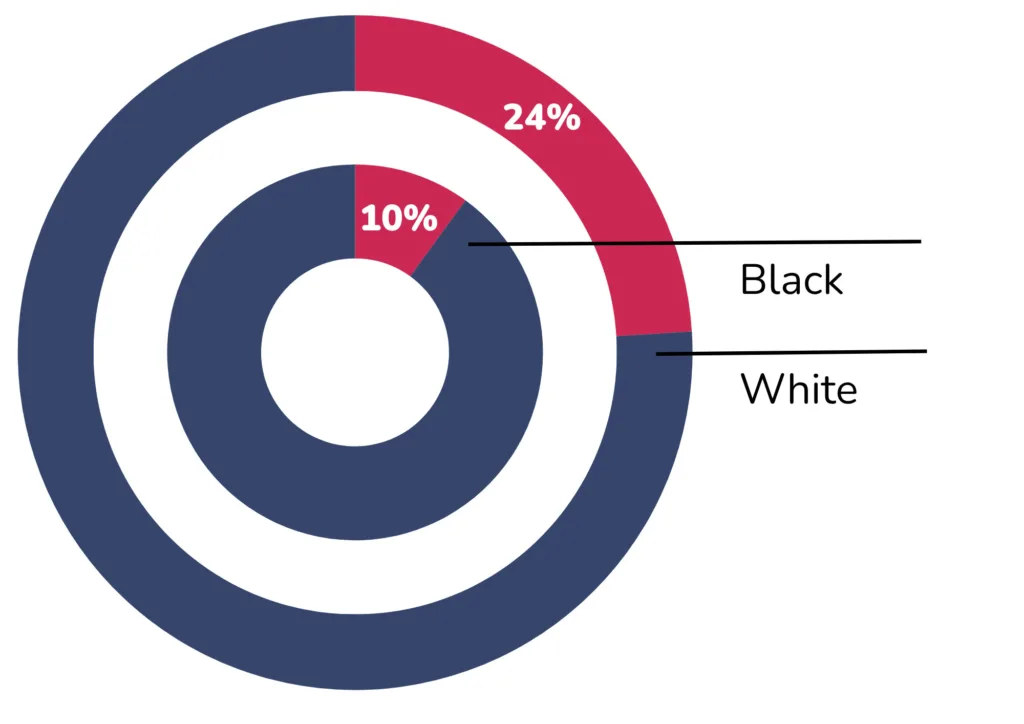
The graph shows that Black families are much less likely to be offered social housing through the statutory homelessness system. While 24% of white families secure a home, just 10% of Black families do.
Some people have had to resort to changing their name, accent and hairstyle to try to gain access to housing and other services.
The legacy of racist housing policy in the UK
The past isn’t past. Racist policies and systems from decades ago are still shaping who gets pushed into homelessness and poverty today.
Post-war
After World War II, ethnic minority families who came to the UK were pushed to the margins. Many were denied housing outright or “steered” into the worst-quality social homes, simply because of the colour of their skin. Those shut out of social housing were left in run-down, neglected neighbourhoods. Decades on, those same areas remain underfunded. And generations later, many ethnic minority families are still living with the consequences.
Right to Buy
In the 1980s, the Government introduced the Right to Buy scheme. It offered big discounts to help people buy their council homes. But it didn’t boost homeownership equally. It favoured white families, who were more likely to have the income and stability to buy, leaving ethnic minority families behind.
The impact of this is being seen today:
- A growing wealth gap. As house prices have soared, so has inequality. Today, white families have roughly nine times more wealth than Black families – largely because they’re more likely to own their homes. That gap makes it harder for Black families to build security, pass down wealth, or get on the housing ladder. The result: homeownership rates are lowest among Black people.
- A shrinking safety net. The Right to Buy scheme stripped thousands of homes from the social housing system. With too few new homes built to replace them, more people now rely on expensive private rentals. This shift has hit ethnic minority people the hardest, as they are more likely to rely on renting, with just 14% of privately rented properties headed by someone who is White British.
- A broken promise. Black families are nearly three times more likely than white families to rely on social housing. But after decades of political neglect and disinvestment, that safety net is wearing thin – and the people who need it most are being left with nowhere to turn.
Current policies
Even today, some housing policies are stacked against ethnic minority people – making it harder for them to find a home, hold onto it, or feel safe in it. Instead of tackling racism, these policies are helping to keep it in place.
Right to Rent
The 2014 Right to Rent law requires landlords to check a tenant’s immigration status or face steep fines or even prison time. In 2019, the High Court ruled that the policy is discriminatory. A decision later overturned by the Court of Appeal, which found that the discrimination ethnic minority renters face as a result of the ruling is justified.
To avoid risk, many landlords choose the “safe” option: renting to White British passport holders – shutting the door on potential ethnic minority renters, even though they are perfectly entitled to rent.
The result?
- Nearly half (44%) of landlords and agents say they’re less likely to rent to families who look like immigrants.
- Ethnic minority people can spend twice as long searching for a home compared to white people.
How No Recourse to Public Funds causes homelessness
No Recourse to Public Funds (NRPF) blocks non-UK nationals from accessing benefits – even if they’ve lived, worked, and paid taxes here for years.
People with temporary immigration status are shut out of most welfare support. That means no housing help, no Universal Credit, and no safety net if things go wrong. Lose your job, and you’re on your own.
For people with NRPF, homelessness is just one setback away. Many skip meals, rely on food banks, and fall into debt – simply because the system they’ve paid into says they can’t get any help.
Celal was one of them. During the pandemic, he lost his job – and with no access to support, he lost his home too.
Life was going great. I had a flat in Primrose Hill, worked as a corporate actor, and had a producer job. Homelessness wasn’t something I ever expected. But as soon as the pandemic hit, my work stopped, I had no safety net, and I couldn’t pay my rent.

How structural racism fuels homelessness and poverty
Ethnic minority people are more likely to experience racism in everyday life, from job applications to the criminal justice system. These inequalities pile up and push people closer to the edge.
- Poverty: In the UK, ethnic minority people are over twice as likely as white people to be living in deep poverty and at risk of homelessness.
- Employment: Black workers face greater barriers to job opportunities, career progression, and fair pay. They’re less than half as likely to hold leadership positions compared to the wider workforce.
- Prison: Black people are more likely to be imprisoned – and to receive longer sentences for the same offences as white people. Many leave prison with nowhere to go and no support, feeding a cycle of homelessness that’s hard to escape.
Ways to address racism in the housing system
Ending systemic racism takes collective, long-term action. Inequality is baked into the UK’s history, its housing policies, and its welfare system. We need to change that – and we need to do it together.
Back in the 1980s, Black and Minority Ethnic Housing Associations were set up to challenge a system that was failing marginalised communities. They open doors to better housing. But the job isn’t done.
We still need more diversity in the homelessness and housing sector, especially at senior levels. Leaders with lived experience bring the insight and urgency we need to break down the barriers that hold ethnic minority people back from stable housing and fair work.
At Single Homeless Project, we’re committed to tackling these inequalities head-on. Our expert teams support ethnic minority Londoners through the maze of housing and immigration systems – because no one should be left behind by bureaucracy.
Internally, our staff-led Black and Minority Ethnic Network is pushing us to go further, advocating for equality across our charity and helping us better support both our colleagues and the people we work alongside every day.
Everyone deserves a safe, secure, and affordable place to call home.

Follow us on social media