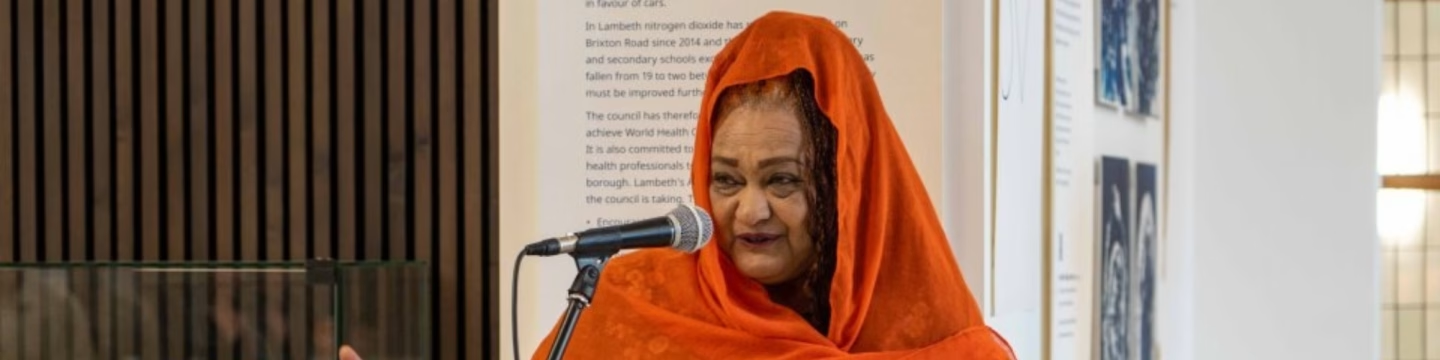
When Haja fled to London, she had gone through years of trauma. Her political views and journalism made her and her family a target for the Sudanese Government. Our Refugee Resettlement service helped Haja the moment she arrived in the UK. We gave her family a home and the support needed to build a life in a new country.
“The Sudanese Government kidnapped me and raped me when I was 14 years old on my way back from school. My father was the leader of a political party that opposed the Government at the time. This was their way of targeting him and my family.
“After that, we packed everything up and moved from place to place for safety. Our safety was threatened.”
Despite her harrowing experiences, Haja, like her father, became vocal against the Government.
“At the University of Khartoum, I became more politically active and spoke out against the Government’s injustices to women and human rights.
“After university, I trained as a journalist and wrote for the newspaper. I was constantly in and out of prison because of my work. I can’t even count how many times the Government took me in.”
Survival and sacrifice
This pressure forced Haja to quit journalism and start teaching at the university. There, she met her ex-husband, a political activist himself, and had her four kids with him. It was a new life, but she wasn’t doing what she loved. She started writing again but soon realised that it was endangering her family.
“My husband and I were kidnapped. That day, he was raped in front of me and completely forgot who his family was after that. He said he wasn’t a man, didn’t have children, and had never had a wife. He was suffering from PTSD. From then on, it was me and my children.
“Death threats were made against my family. It was an awful time. I hadn’t thought about leaving Sudan before, but I knew I needed to go for my family’s safety.
But deciding to leave was, in many ways, the easy part for Haja, who had to overcome many hurdles to leave the country.
“We didn’t have passports or visas, and I needed approval from a male family member to travel out of Sudan as a woman. I got this from my cousin – but when I got to the airport, they told me I had been redlisted from leaving the country.
“I knew we still needed to leave somehow, so we took a bus to Wadi Halfa, near the Egyptian border, and walked for 13 hours through the night. Our documents were checked, and we took a taxi straight to the United Nations.”
A new beginning
Haja was connected with charities in Egypt, which gave her a place to stay and support. But despite leaving Sudan, the troubles Haja and her family faced followed them. For her safety, Haja was offered travel to London, and she took it.
Isobel and Marwa from Single Homeless Project’s Refugee Resettlement Team welcomed her and her children with open arms at Heathrow.
“I had so many things going through my mind: ‘What would happen to my children?’, ‘What is the UK like?’, ‘Will I be safe?’ It was challenging physically, too: I was in a wheelchair after I was attacked and had my knee broken. It was a horrible time.
Isobel and Marwa met me and my four children with a warm welcome. They were the first people I saw smile at me in a long time. It had been so long that I'd forgotten what smiling looked like.
“Isobel and Marwa took us to our new house in Lambeth, which was beautiful. I remember Isobel cooking us lamb. It was the first time I had had it since leaving Sudan. I couldn’t have asked for anything more. I knew I had someone to look after my children, and we were finally safe.
“After we settled, Isobel helped get two of my children to school with extra help as they didn’t speak English. The younger ones were too little for school, so a tutor taught them at home. My kids are all at university now!
“When I arrived in the UK, I didn’t have a life. I was a woman alone with four children. I don’t know how I would’ve managed without Isobel. She’s my family. I called her my young mother.”
Creating community
With our help, Haja has built a life for herself and her four children in a new country, and they are flourishing.
Haja wants to help others like her, too. Drawing from her experiences as a refugee in London, Haja is creating a place where people from different backgrounds can meet and learn about each other’s cultures with a refugee-run café.
We’re so proud of you, Haja!
Follow us on social media