
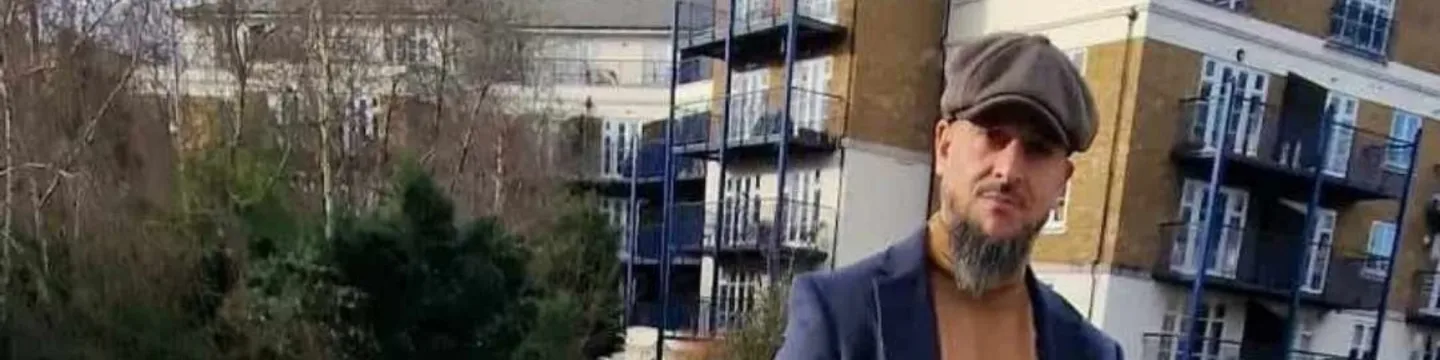
Adam had a tough start in life. Growing up in a rough part of East London in the ’80s, he lacked stability at home and school. After prison, he struggled to reintegrate into society; his relationship broke down, and with no options left, he became homeless. Adam moved into one of our hostels in Northeast London, where our team gave him the support he needed. He now lives in his own home and hopes to work as a counsellor.
“We moved around a lot during my early years. My dad was a builder. We would move into a house, Dad would do it up, and then a year later, we’d move elsewhere.
“I was always changing schools, unable to settle. It left my education in tatters. I didn’t collect a single certificate.
“At home, my mum and dad got into a lot of fights. They eventually broke up, and I never had much contact with my dad again. It was an unstable childhood.”
Lacking qualifications and support, Adam struggled to fit in. He fell in with a group involved in crime. He did his best to stay away from it, getting married and trying to find stability through work. But at 23, Adam lost control and spent 16 years in prison.
“I had never done anything criminal before. I didn’t want to choose that life for myself. It was a one-time thing, and I regret it every day.
“I did a lot of learning in prison. I gained my GCSEs and got a scholarship at Westminster University. Then, I studied at Kingston University. I finished my studies when I got out and started working as an IT Junior Manager. My ex-wife, with whom I have a kid, and I remarried in prison six months before my release.”
Navigating life after prison
It felt like Adam was on the right path, rebuilding his life. But things weren’t that simple.
“I found it hard after my release. I had to get used to life outside of prison. My wife started to push a lot of guilt onto me and became controlling and resentful. I had nowhere to go but felt like I had to leave the house and my kid.”
Adam began sofa-surfing at friends’ and family members’ houses before sleeping in his company’s van.
“I worked as an engineer for Whirlpool UK, repairing washing machines and fridges. I had a van, so I started sleeping in it at night. It was cold, but it was better than being on the street.
“I kept working as usual, hoping no one would notice anything different. After everything that had happened, I didn’t have the mental energy to find a flat. It all felt too overwhelming – a mountain of a decision.”
Facing the stigma
Like many people coming out of prison, Adam didn’t tell his employer about his full criminal record. He was only offered jobs when he kept that information to himself. Many people leaving prison face this challenge when trying to reintegrate into society.
“One day, I got a call from my manager telling me I had to stop working immediately. My ex-wife had told him about my criminal record. I was fired that same day and lost the van.”
Adam had lost the last stable thing in his life.
“I spent six months sleeping rough in East London. I was too embarrassed to admit my situation to my family.
“The streets were horrible – cold and lonely. I spent most of my time in the library.
“Some nights, I would shelter near a block of flats. On others, I’d take cover under some bushes. I was lower than low. I’d have preferred to be in a prison cell rather than homeless on the streets.
“I knew of places where I could get food and wash up, and sometimes I would go to my family for dinner. They still didn’t know about my situation. I only told them once I went into a shelter.”
Adam was connected with StreetLink and found by an outreach team some weeks later. We first met Adam when he moved into one of our hostels in Northeast London.
When I first visited the service, I went 'wow.' At that moment, it felt like a penthouse. It was my place with my own key—a key to my freedom. It was like the prison gate being opened for me. I could walk in and out of my door as a free man.

Restoring relationships
Adam spent eight months with us, where we helped him process trauma, prepare for legal proceedings, and rebuild community ties. After a stay in our hostel, Adam moved to a temporary flat where we continued supporting him. Adam is now working as a courier and training to become a counsellor, using his experiences of being homeless and his time in prison to help others.
“My ex-wife was making claims and threats against me. She would also use our child against me. The hostel team helped me with court proceedings, and the judge cleared me of everything.
“I have so much experience with trauma that I want to use my perspective and become a counsellor. I know pain. My life experience lets me empathise with those suffering like me. I want to give something back to the world.
“I love having a place to call home, somewhere I can have my daughter over. The place still needs some work, but I’m so excited!”
Unfortunately, thousands of people leaving prison become homeless. Our specialist offender teams help hundreds of Londoners like Adam to prevent this. We support people with housing, reintegration into the community, and building fulfilling lives.
Everyone deserves a place to call home.

Follow us on social media