

London is in crisis. Every 7.5 minutes, someone is forced into homelessness in London – it’s the pace of a broken system.
Political choices, systemic neglect, and a housing market built for profit, not people, all play a role. And in the capital, where housing is even more scarce and unaffordable, those failures hit harder, faster, and deeper than anywhere else in the UK.
These are the four biggest drivers of homelessness in London – and every one of them is preventable.
Not enough affordable housing
Housebuilding in London has fallen catastrophically short. The Greater London Authority estimates that London needs a net addition of 42,841 affordable homes per year between 2016 and 2041 to meet demand. But 2023-24 saw just 7,674 affordable homes added – a shortfall of over 35,000 homes.
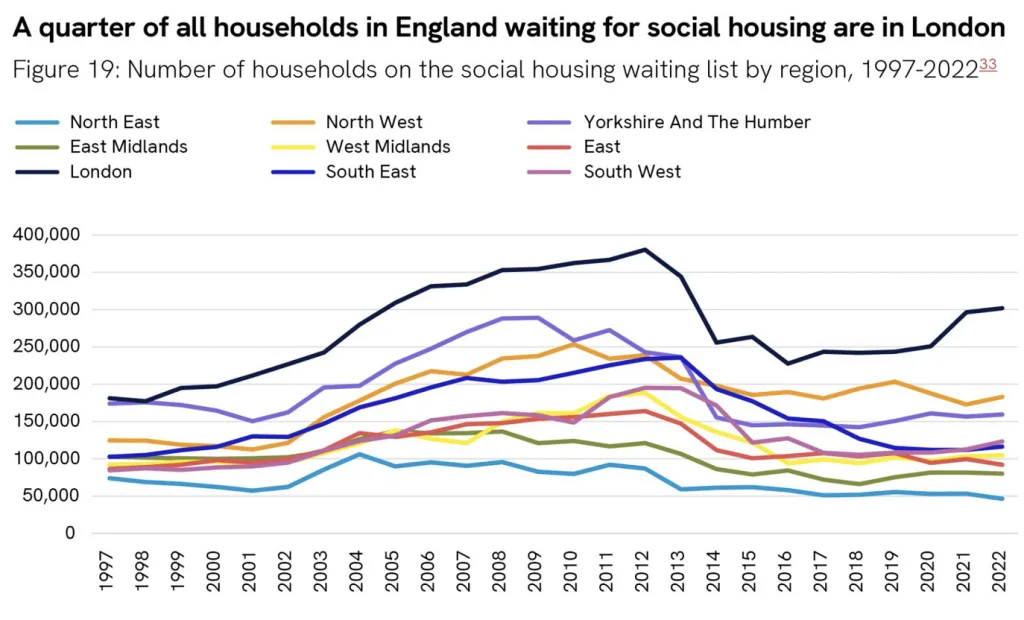
Meanwhile, 336,366 households are on London’s social housing waiting list – the highest level in over a decade. That’s one quarter of all households waiting across England.
As social housing supply fails to meet the need, more Londoners are pushed into the private rental sector – often landing in unaffordable, insecure, and unsuitable housing.
Labour’s promise of “the biggest boost to affordable housing in a generation” – with £39 billion pledged over the next decade – is a welcome shift, and a sign that the housing emergency is finally being taken seriously. But many experts have warned it still falls short – and we’ve yet to see that promise backed by action.
As the supply of social housing fails to keep up with demand, more people have to rely on the private rental sector. This is often unaffordable, unsuitable, and risky.
A risky private rental sector
London’s private rental market is broken. Rents are soaring. Conditions are slipping. And tenants are paying the price.
Since 2015, Londoners have spent between 40% and 57% of their income on rent. That’s well above the Government’s own affordability threshold – and far beyond the 32% tipping point, where homelessness begins to rise sharply as rents outpace incomes.
People are doing everything they can to stay afloat – but the odds are stacked against them. And even if you do nothing wrong. You can still lose your home at a moment’s notice…
A political choice to keep ‘no-fault’ evictions
Imagine being forced out of your home with little warning and no explanation. That’s the reality of a Section 21 eviction. These ‘no-fault’ evictions give landlords the power to uproot people at any time.
Across England and Wales, around 500 renters receive a Section 21 notice every day – nearly one person every three minutes. In London, no-fault evictions rose by 52% to 11,880 between March 2023 and 2024 – an increase more than five times the rise seen in the rest of England and Wales.
Since the government first pledged to scrap no-fault evictions in 2019, over 108,000 households in England have faced eviction after receiving a Section 21 notice – and nearly 35,000 have been evicted by force.
When the Labour government came to power in 2024, they promised to scrap Section 21 through the Renters’ Rights Bill – a step we welcome. But it’s not law yet, and it won’t undo the damage already done.
Thousands have already lost their homes. The impact won’t vanish overnight – and for many, the trauma will last a lifetime.
Discrimination and inequality
A person’s ethnic background affects their chances of homelessness in London more than anywhere else in the UK. It’s the result of long-standing racial inequality baked into housing, welfare, and economic systems.
Here are the facts:
- Black Londoners are four times more likely to be homeless than white Londoners.
- Five of London’s ten most ethnically diverse boroughs have far higher eviction rates than the ten least diverse.
From discriminatory lettings practices to insecure jobs, people of the global majority are being hit hardest at every stage of the housing system.
Single Homeless Project began in 1975 when six homeless Londoners set out to challenge the system and make their vision of a safe place to live for everyone a reality. A lot has changed since then, but our spirit hasn’t.
In a city where hundreds are forced into homelessness every day, our work has never been more needed or more challenging. And we’re not shying away. We’re rolling up our sleeves to make change and help over 10,000 Londoners every year.
We prevent homelessness, provide safe places to live and give people the opportunity to rebuild their lives and transform their futures. And we never give up.
Homelessness doesn’t define you. It’s an experience, not a forever and it can be ended.
Want to learn more about our work? Sign up for our newsletter or follow us on all major social media platforms to stay in the loop.

Follow us on social media