

Work with perpetrators & survivors of domestic abuse
At Single Homeless Project, we recognise that there are strong links between homelessness and domestic abuse, especially for women.
“I feel ‘am I enabling this relationship, am I allowing this relationship to continue through my support’?”
Women experiencing multiple disadvantage and domestic abuse are among the most marginalised in our society. Research and experience have shown that they face considerable barriers in both identifying their experience as abuse and getting the specialist support that they need.
These women are also more likely to stay in a relationship with their perpetrator for reasons related to trauma and environments, meaning frontline workers are often working in highly delicate dynamics where both the survivor and perpetrator are present.
This means frontline teams in homelessness support settings are required to work with both survivors and perpetrators of domestic abuse, sometimes within the same service., and often with little guidance on how to do so safely. In order to keep survivors safe and enable them to access the support they need, we firmly believe we need to also work with perpetrators.
,We are committed to working with partners to make sure survivors of domestic abuse receive the right response and support every time.
Housing First For Couples
Single Homeless Project and Solace Women’s Aid have collaborated to design an innovative Housing First service for couples experiencing entrenched homelessness, where there is suspected or known domestic abuse being perpetrated within the relationship.
Read a full feasibility study conducted into developing this new Housing First service in London.
The proposed Housing First model aims to reduce and mitigate the risks to survivors, whilst ensuring that domestic abuse does not deny either survivor or perpetrator access to the stable housing, health care, and specialist support that they need. The model provides separate, but concurrent, independent housing and wrap-around support, delivered by a specialist multi-disciplinary team and overseen by a cross-sector network.
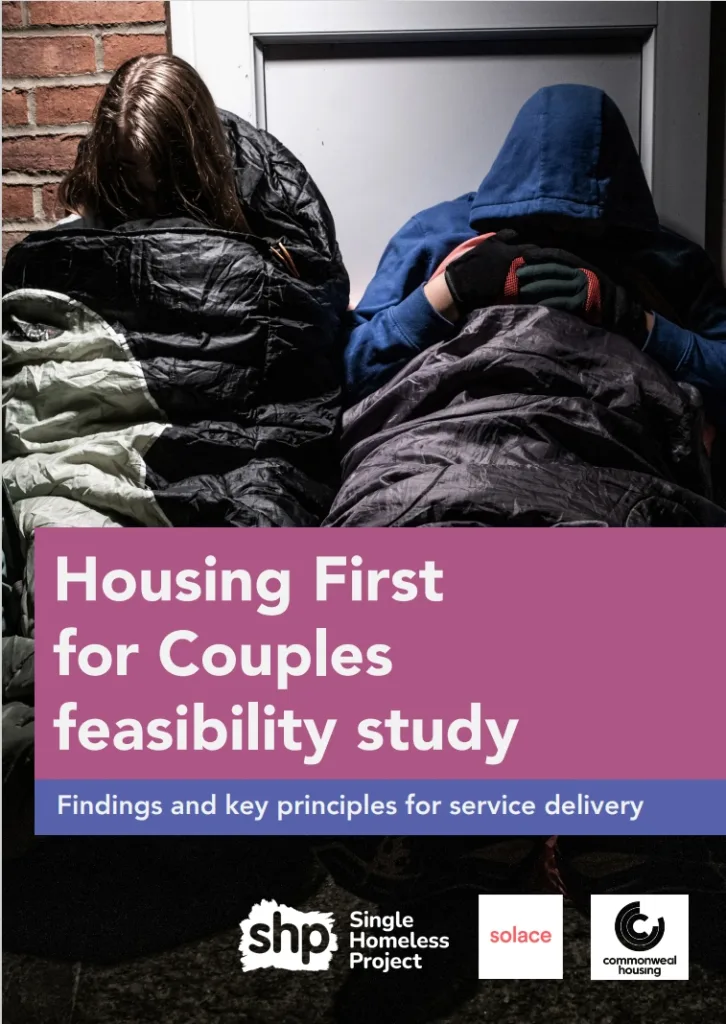
Funded by Commonweal Housing and driven by the voices of survivors with lived experiences of homelessness whilst in a couple, the new report explores the feasibility of the service and sets out key principles for safe and effective service delivery. We are delighted that we will soon put the learning in to practice, as SHP and partners will be delivering a new SHAPs funded Housing First service with a couples specialism, commissioned by Camden council, from April 2025.
We know that long term homelessness and rough sleeping is dangerous and deadly for everyone, and that’s especially true for survivors of
domestic abuse. We have high hopes that this new model will improve
the wellbeing and life chances of couples, whilst always prioritising the choice, autonomy and safety of the survivor.
Guidance – working with survivors and perpetrators
This guidance will outline how to do work with survivors and perpetrators effectively and, most importantly – safely. We’re proud to have worked with Standing Together to create practical guidance:
For professionals in homelessness settings. Read the guidance here: Working Effectively with Perpetrators and Survivors of Domestic Abuse in Homelessness Settings.
For supported housing/Housing First providers and commissioners on best practice when housing and supporting perpetrators of domestic abuse.
Read the guidance for service providers here
Read the guidance for commissioners here
This guidance provides practical advice for homelessness practitioners working on the frontline as well as points for consideration by those in strategic roles that have the power to embed the guidance within their organisation or local area. The aim of the guidance is to;
- Increase safety for survivors experiencing multiple disadvantage
- Where appropriate, to motivate perpetrators of domestic abuse to recognise and address their behaviour and support them to access appropriate help where possible.
- Improve the skills, confidence and safety of practitioners working in these scenarios.
Watch the launch webinar for advice, which includes our Head of Multiple Disadvantage, Lucy Campbell, talking about a couple’s pilot that Single Homeless Project were involved in, click here. You can read a case study on the pilot (which housed a couple together where there is a known risk of domestic abuse here.
Training – ‘Confidence in Complexity’
Alongside Standing Together, we run a training course to run alongside the guidance.
The course will allow practitioners to increase their knowledge, skills and confidence when working with survivors of domestic abuse, perpetrators of domestic abuse or encountering both simultaneously, within the context of multiple disadvantage.
The training was piloted and developed with the support of local homelessness services and can be delivered over one-day in person or virtually across two three-hour modules
For more information or to discuss how this course can best meet the needs of your organisation, please contact Lucy Campbell, our Head of Multiple Disadvantage, at lcampbell@shp.org.uk
Training Evaluation
Both the guidance and a training package, which work to improve identification, responses and referrals for victim/survivors and perpetrators into appropriate services and interventions, were evaluated by our partners PraxisCollab.

Follow us on social media